
My dog has stomach problems
My dog has stomach problems
Stomach problems are one of the most common reasons why dogs come to the vet. If your dog has one of these symptoms, it may have problems with the stomach/intestinal system – digestion:
- Diarrhea, loose, loose stools or blood in the stool
- Constipation
- Vomiting, poor appetite
- Rumbling stomach, bloating, hiccups, burping, farting
- Depressed, sad
Help your dog with stomach problems
You have several options to help your dog or cat if it has stomach problems:
- Order an online consultation at +45-2329 2959 – you get help online with videos and photos
- Take one of our courses or the vet. certified education - see more
- Look in my books on dogreflexology
My dog has stomach problems - good points
I'll show you a few points that you can use to boost your dog's stomach and pancreas. The points are also especially good during the Christmas period. Many dog owners, in a misguided kindness, give their dogs treats during the Christmas season; pork rinds, duck fat, delicious brown sauce, butter-baked Christmas treats and other things in the same category. This can result in a serious inflammation of the dog's pancreas and if it goes completely wrong, the dog can actually die from it. It's called pancreatitis, and dogs are especially affected by this serious disease during the holidays.
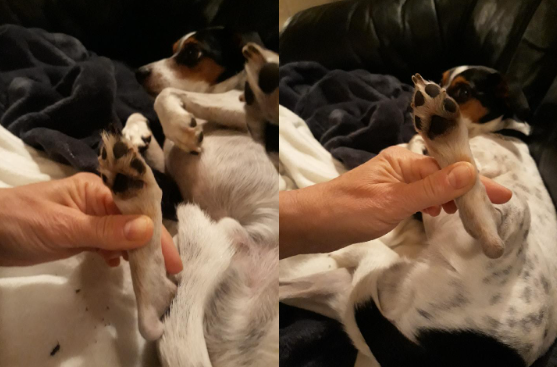
Massage in circular motions around the reflexes on both hind paws, preferably for 1-2 minutes on each paw 1-2 times daily.
There are many good offers for dogs: antlers, which most people enjoy chewing and which contain good minerals. Dried meat such as duck and fish are also a hit with dogs.
Dog with stomach problems - Meg
Read the full story and see before/after pictures of Meggy with stomach problems
Meg had severe stomach problems - she:
- Would not eat
- Vomited
- Was so swollen that she had difficulty lying on her stomach
- Was very tired and just wanted to lie in the basket all day.
On this pic you see how swollen Meg is. This is before reflexology.

The first blood sample 4th January showed that Meg's liver count (ALT) was very elevated. IT WAS 1308 AND THE NORMAL RANGE IS 0-40. An X-ray showed an enlarged liver, but the cause was unknown.
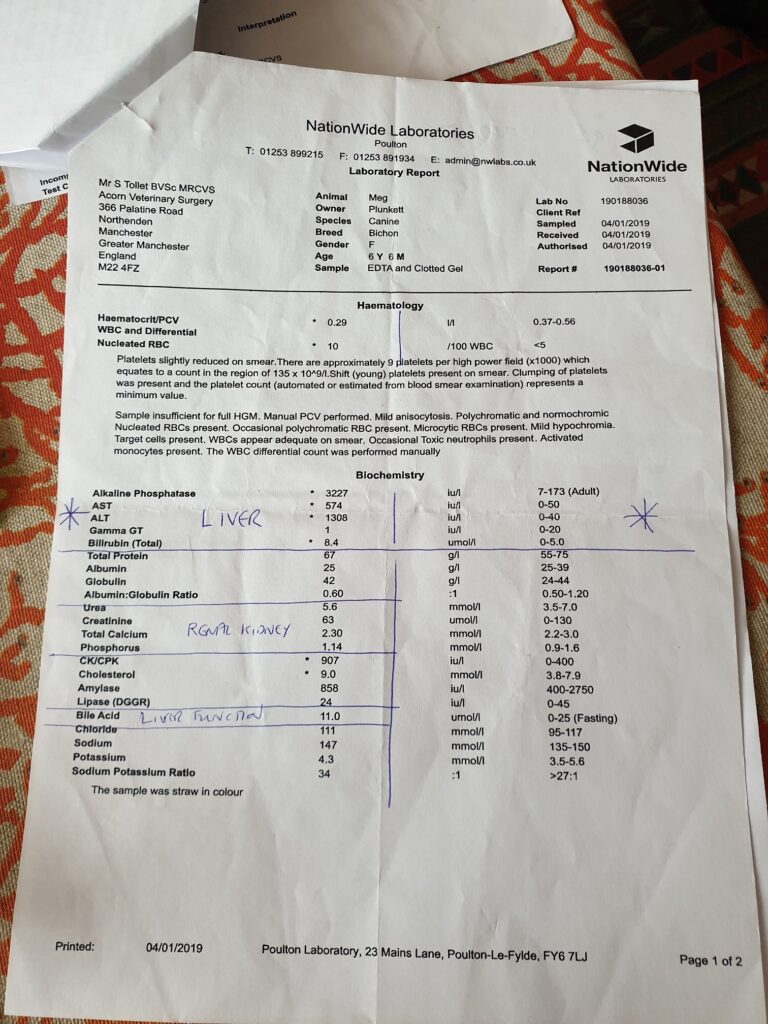
ADRENAL CORTIC HORMONES DID NOT HELP, ON THE CONTRARY
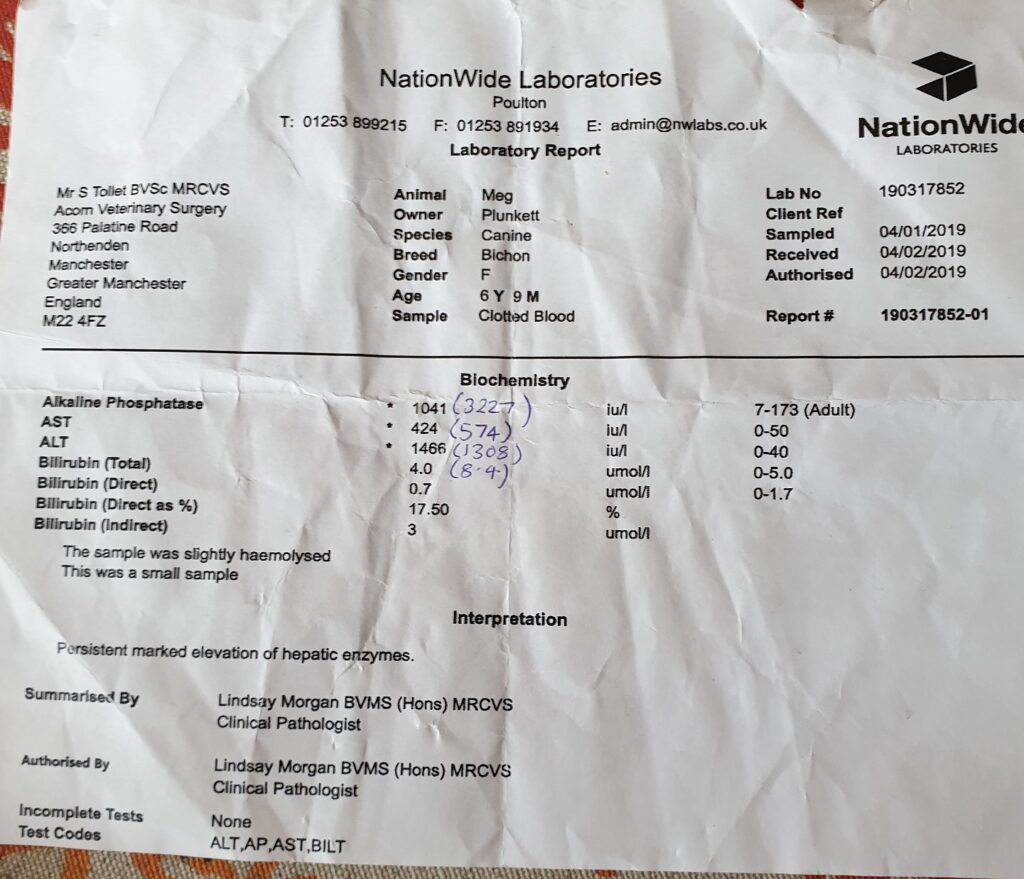
The vet gave her adrenocortical hormone and after 1 month a new blood test showed that the liver count had become even higher (from 1308 to 1466), but the vet continued the same treatment. Here is the blood sample 2 from 2th February:
Because I was in Manchester to teach, I was able to give Meg intensive reflexology for 3 days and taught the owner points to massage on Meg. I also suggested homeopathic medicine together with the adrenal cortic hormones.
The elevated liver counts only decreased when she received reflexology
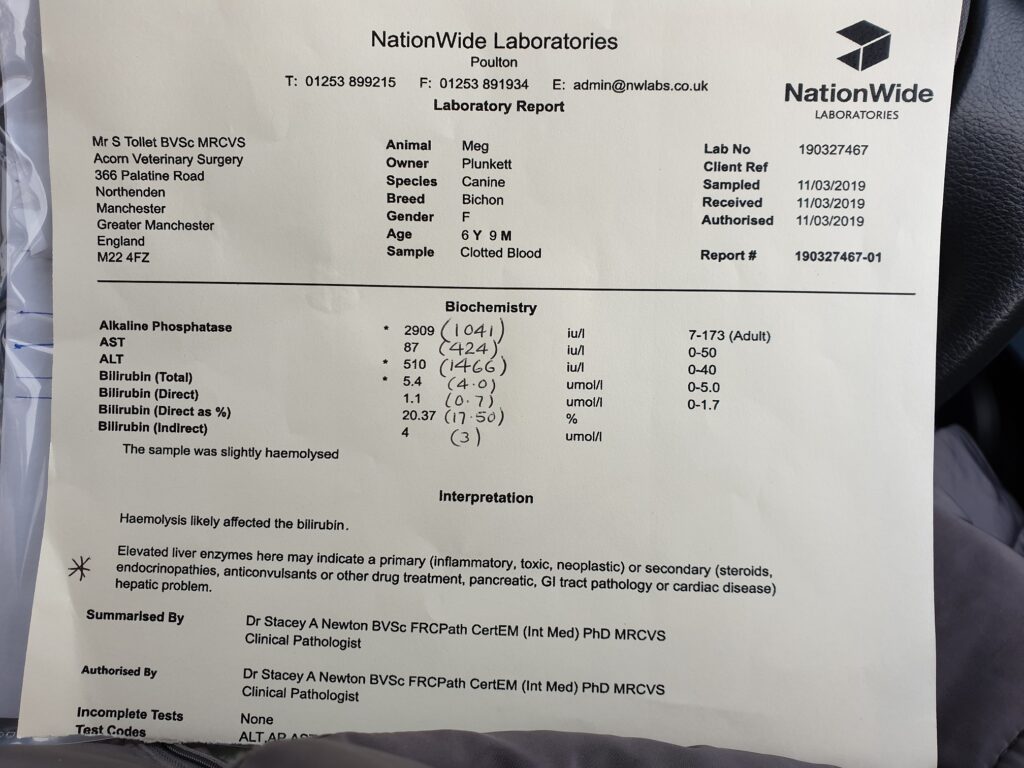
11 days later a new blood test showed that: The liver count HAD FALLED FROM 1466 TO 510 - fantastic as it has helped Meg. Here is the last blood sample:
Meg after reflexology - the swelling is gone and she is able to lie on the stomach!

Completely herself again
Meg now is eating, playing and having good walks. The owner is continuing with her reflexology and homeopathy, so we get the liver counts completely right. The vet has taken Meg off the adrenal cortex hormone and has recommended reflexology and the homeopathic medicine, that I suggested. Here you see a healthy Meg who can now lie on her stomach.
Dogs and stomach problems:
- Food: You are what you eat – also applies to the dog. You can get several brands of good quality. I avoid grain, as storage mites appear in moist grain and can cause allergies. Change the protein source occasionally, for example from fish to sheep, to reduce the risk of intolerance/allergy.
Cookies and the like are neither good for the dog's digestion nor teeth. - Allergy/intolerance: Stomach problems can easily be caused by food allergy or food intolerance. Read about dogs and allergies here. It can be difficult to find out which food the dog is allergic to. Try an elimination diet: Switch to a protein source that the dog has never had before, such as ostrich, goat, horse, deer, etc. To see if the dog can tolerate the new food, it must not be given anything else for 8 weeks, including treats and chew bones. Buy dried duck meat, for example, if it has not had it before, and use it as treats. After the 8 weeks, you can switch to the old food, and if the dog does not scratch, you know that it is not allergic to the old food. If it scratches, it is allergic to its old food. But if the new good food works, it is beneficial to continue with it. You can also choose to Barf your dog. Here it is important that you find a dealer who has a complete check on Barf. Previously, you had to pay close attention to the distribution of the raw meat: tripe, bones and cartilage, offal and other meat. Today you can get a mixed product that contains everything, so it is much easier to barf today. If you want to try different treats and chews, you take one product and try it for 14 days. If the dog doesn't scratch it off, you can try another for 14 days and so on. That way you can make a "positive list" of treats.
- Stress: If your dog is stressed, digestion is affected and this can cause stomach problems. This is because stress affects the nervous system's fight-flight system, which neither the dog nor we have control over. But we can remove/reduce the factor that makes the dog stressed. Think about your dog's everyday life - and see if there are stress factors that affect it. These can be fear, sadness, pain, divorce, moving, loss of a 2- or 4-legged friend, other illness in the dog, lack of or incorrect stimulation resulting in frustration, restlessness, shouting or violence in the dog's environment.
- Good microflora in the intestine: The right and good bacteria (intestinal flora) are very important both for the intestines themselves and for the immune system. There are several good natural products with lactic acid products – I use Vita Biosa for animals myself. If your dog has taken a lot of medication, such as antibiotics, the intestinal flora may need a boost with good bacteria from lactic acid products.
- Organs: The stomach, intestines, liver, gallbladder and pancreas are all important for digestion. Read the story of Meggy and her liver at the bottom of the page. For example, poisoning can damage the liver. This can affect digestion itself, as the liver supplies important substances to break down food.
Entry form for course

Vivian Birlie
Vivian Birlie is a reflexologist, acupuncturist and author. Since 1997 she has treated both humans and dogs. She has been teaching reflexology and acupuncture since 2000.
During her long-time as an educator, Vivian Birlie has authored a great deal of teaching material. This background, along with 16 years of experience in journalism and technical computer knowledge at the Danish Broadcasting Corporation, has made Vivian’s books possible.
Her 2 books about dog reflexology and acupressure in English are:
- “Dog reflexology and acupressure” , a textbook. The Danish edition was released in August 2016 in Denmark and the English version was published in January 2017
- "Dog reflexology and acupressure for owners" (Gyldendal 2019). The Danish edition was published in January 2018. It descibes how you as a dogowner can help your dog (and as a matter of fact cats as well) with pain, discomfort and problems – including behavioral problems
Education and courses:
She teaches at her Sano Canis Institute, which offers a one-year veterinarian certified dog reflexologist education. It takes place in Denmark and England - Read more abot dog reflexology. Vivian also gives lectures and teaches courses in human acupuncture and reflexology. On her facebook page, you can get good advice on how to relieve the most common disorders in dogs and cats.
Vivian also gives good advice on the Danish Kennel Club's website and Facebook page.
Vivian also gives lectures - contact her to hear more.